
How much does it cost to run? The invoice invisible, running, and why every time we spend more
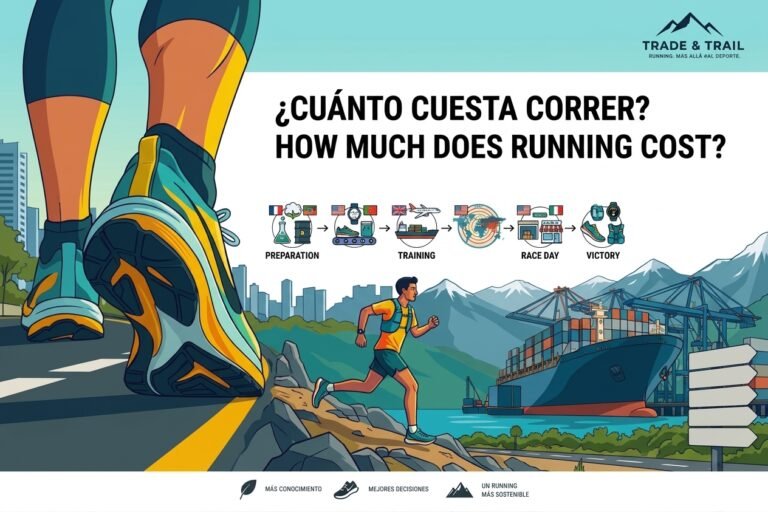
Andrew is 51 years old. Elena, 47.
None lives to the sport.
they Both go out for a run four times a week, share workouts, have completed several half marathons and both build the same excitement and respect the leap to the distance of Filípides.
When they had to renew their shoes as they discovered a reality that is shared thousands of popular runners: run remains simple, but the running has become increasingly expensive.
Each time we run more. Every time we spend more.
Andrew and Elena are the accurate portrayal of the popular runner contemporary: professionals working days the demanding family responsibilities and an absolute passion for slipping on shoes, four days a week to disconnect, maintain health and overcome their own limits.
After you have accumulated together the medal of several half marathons, both have begun to plan with the same enthusiasm for their next great shared goal: run his first marathon. It was precisely during this preparation when agreed in a gesture that any broker makes sooner or later: browse through a specialty shop to renew the pair to face the long shoots of the weekend.
At that moment, both were staring at the screen in silence for a few seconds:
- Models of daily training: 180 euros.
- High-end tourer: above the € 210.
- Models with technologies of advanced foam and fiber: easily overcoming the 250 or 280 euros.
The surprise was not born of a rejection of sharp to the value of the product, but the impact of the memory. When both of them began to run, a little more than a decade, a shoe upper-middle range of brands cost a little more than 100 euros.
But the sneakers are only the tip of the iceberg. When you review your expenses for the last year, they discovered that the costume technician accumulated, the nutrition in the race or in the inscriptions popular events have transformed a hobby fundamentally humble in a relevant chapters within the household budget.
Running is still a physical activity that is simple and accessible, but practiced under the standards of the running modern has become considerably more expensive.
The simplicity of the park to the multi-billion dollar industry
For generations, the greatest virtue of the running to have resided in its austerity. Unlike cycling, skiing or golf, not requiring complex facilities or expensive equipment. Going running was the most pure and direct exercise: it was enough for a pair of shorts, a shirt and a pair of slippers reasonably damped.
Today, the landscape has changed radically. The running has been consolidated as an industrial sector highly sophisticated moves billions of euros a year around the world.
The brand does not structure their catalogs in function of the durability or the basic protection of the foot, but around the concepts borrowed from the professional sport: metabolic efficiency, energy transfer, aerodynamics, optimization and biomechanics. The launches are happening at a frenetic pace. Social networks and the specialized channels make each new version in a media event that it generates in the popular runner a constant feeling of obsolescence.
The industry has managed to transform the narrative of the running popular: since not only sells a healthy practice to be in shape, but a permanent search of the performance through the consumption of technology. It has been installed subtly the idea that in order to make progress, to avoid injuries or to fully enjoy a marathon, it is imperative to have the latest advancement in the market.
A clear example of how we’ve crossed that invisible line that separates the habit of the simple park of the great commercial machinery is to analyze the evolution of the demands of the corridor itself in the last 15 years.
And one of the main examples that we can put to understand how we have crossed that invisible line that separates the habit of the simple park of the great commercial machinery is to analyze what has happened in the sector of the shoes in the last 15 years.
The anatomy economic slipper-modern
To understand why a running shoe reaches today’s prices that would have seemed crazy, fifteen years ago, it is necessary to analyze the global value chain that exists behind each pair.
The equipment of the corridor does not escape the stresses of international trade. Today, more than 85% of sports footwear in the world occurs in southeast asia (most notably in Vietnam, China and Indonesia). This means that the price that Andrew or Elena pay at your local store is conditioned by costs of freight, duties, fluctuations of commodity petrochemicals and tensions in the global supply chains.
However, to attribute the rise in the cost only to the cost of logistics, it would be wrong. The real revolution has been technological and conceptual.
The arrival of the thermoplastic elastomers (PEBA, TPU expanded), and the rigid plates of carbon fiber was a turning point. For the first time in the history of the sports shoes, the industry is not promised to simply absorb the impact, but return energy biomechanics.
The science supported part of this leap in technology. Pioneering studies have documented improvements in running economy (a reduction of the metabolic demand at fixed speeds) between a 2% and 3% in well-trained athletes using the first generations of superzapatillas. Subsequent investigations confirmed the existence of these gains, although provided a hue critical: the magnitude of the improvement has a huge individual variability.
For an elite athlete to dispute a victory by thousandths of a second, a 2% improvement in metabolic is the border between the glory and oblivion. But for a popular runner whose priority is to cross the finish line with health, manage fatigue and to enjoy the process, the question changes completely:
how much added value it brings that technology to the improvement of the biological factors and training?
The anatomy of the budget: Andrew vs. Elena
To clearly assess the disbursement of a real fan, it is imperative to break down the costs annual recurring.
The real economic problem of the popular runner is not the existence of expensive products, but the impulse buy of a material under the mistaken premise that a high price will replace the daily work.
To understand it clearly, we return to the story of our protagonists:
Andrew embodying the Runner (focusing on the impetus and the direct consumption of material) while Elena will represent the Broker B (focus on the biological performance and the rational planning).
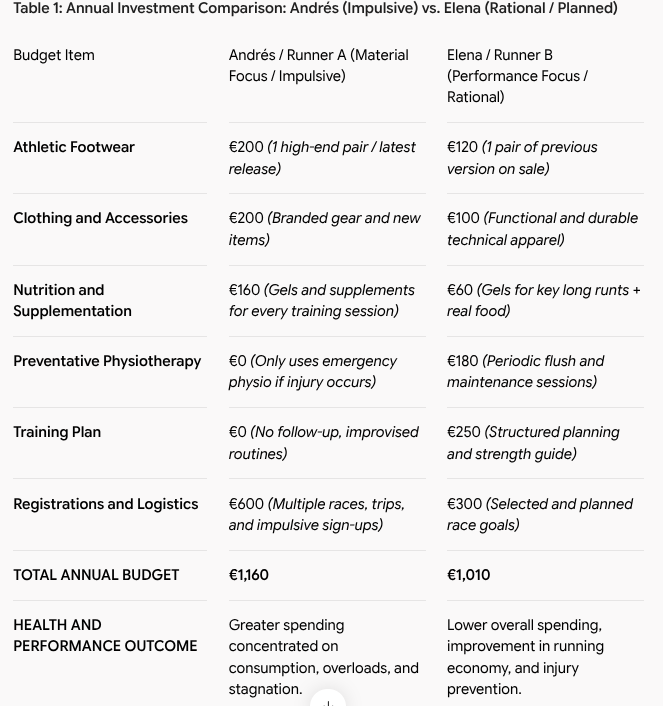
The conclusion that arises from this financial breakdown is incontestable: Andrew spent 150 € more per year that Elena (1.160 € front 1,010 €), but it gets a performance substantially less, and assumes a much higher risk of falling in an injury.
Andrew spends most of its budget on direct consumption (shoes of the latest generation, textile, seasonal, travel, improvised and inscriptions accumulated without plan) looking for shortcuts that technology can provide, Elena invest in what really becomes the biology of the athlete: a plan of structured training, physical therapy, preventive, and an intelligent management of the loads.
The investment with true return: that which is not sold in a shop window
As the sports material gains in sophistication and price scale on the shelves, it is tempting to forget that the exercise physiology has decades of showing: the real engine of the corridor is biology, not your equipment.
One of the papers most cited in the scientific literature on endurance sports is the meta-analysis developed by Blagrove and his co-workers in the prestigious journal of Sports Medicine. In it, the researchers analyzed the real impact of inclusion programs of force structured —which combine maximum strength, plyometric exercises, and work neuromuscular— in corridors of middle and long distance.
The scientific results were conclusive:
- direct Improvement of the economy of race: An increase of between 2% and 8% in the metabolic efficiency, which translates into a lower oxygen consumption at the same speed without the need to increase the body mass.
- Delay in neuromuscular fatigue: Greater ability to maintain a technical running clean and efficient even in the miles more critical of a marathon.
- Radical reduction of the risk of injury: A strengthening structural very top of tendons, fascia, and joint structures against the impact of repetitive asphalt.
The conclusion is revealing: a routine of strength well directed produced in the body of the popular runner adaptations biomechanical and metabolic significantly higher —and more long-term— to which you can provide any carbon plate. In addition, its cost represents a tiny fraction of the price of a pair of shoes high-end.
If we analyze closely, popular runners that are able to improve their marks consistently, year after year, and, above all, manage to do this without falling in recurrence of injury we discovered that your success is built on four essential factors that a trade mark can be packaged in a box:
- The regular cumulative: Accumulate weeks and months of constant training, without interruption forced by overtraining, is the variable physiological number one to enhance the mitochondrial density and aerobic capacity.
- The management of rest and sleep: The adaptations that are invisible to the training does not occur while we run, but while we sleep. To ensure a quality sleep is the intervention recovery more powerful and economical that there is.
- Nutrition with common sense: Load the glycogen stores before the long runs and keep a hydration smart optimizes the metabolic performance much more than any miracle supplement of the last hour.
- Personalized planning: Adjust the volumes, rates and charges to the actual availability of each week —taking into account the stress of work and family— is the only effective antidote to stagnation.
Strategies for a rational consumption
To enjoy the running modern without the personal economy will incur, the popular runner can apply rational criteria of purchase we will provide excellent material maximizing your budget:
- Buy in the change of business cycle: The big brands renew their models every 12 months. Often, the changes between versions are cosmetic or minor adjustment in the upper. Expect to launch the new version in order to acquire the above allows you to get running shoes of maximum level with discounts of between 30% and 50%.
- Rotation rational shoes: Keep two pairs in rotation (one more cushioned for shoots soft and the other more agile series or rhythms alive) not only prolongs the useful life of the foam to allow the material to recover its structure between sessions, but that reduces the overhead for impact repetitive.
- To evaluate the real need before you compete: For rates that exceed 4:45 – 5:00 min/km, a training shoe lightweight or composite without carbon plate tends to offer more stability, better accommodation of the tread over the hour and a significantly longer service life.
- Prioritize the value on the price: Redirect capital towards an assessment biomechanics, a stress test or medical advice from a qualified fitness trainer is the decision that’s more about the rider to their objectives.
Frequently Asked questions (FAQ)
do I need to spend more than 150 € for a shoe guarantees to marathon?
No. The segment of training shoes cushioned (120 € – 150 €) offers extraordinary models capable of dealing with full warranty on both preparation as well as the own-race than a marathon for the vast majority of popular runners.
How long has it encouraged the practice of running popular in the last ten years?
Considering the technical equipment of high-end, nutrition specialist and registration fees test mass, it is estimated that the cost to compete with a profile tech has experienced an increase in accumulated between 35% and 60% in the last decade.
What is recommended by the use of shoes with a carbon plate for all kinds of rhythms?
The evidence biomechanics indicates that the carbon plates deliver maximum benefit elastic rhythms agile (below 4:15 – 4:30 min/km). Rhythms more moderate, the stiffness of the chassis can generate greater overload on the muscles of the foot and the soleus, if not with a refined technique.
What brings greater performance: a pair of shoes of maximum range or a program of strength?
The meta-analysis, scientists consistently demonstrate that the inclusion of a program of muscle strength structured (2 days a week) produces improvements in running economy between 2% and 8%, in addition to drastically reduce the incidence of injury, far surpassing the marginal gain of any material changes.
How long is it advisable to renew the running shoes?
The durability depends on the weight of the corridor, his technique and the common land, but most of the foams modern retain their absorption properties optimal is between 600 and 800 miles of use accumulated.
Conclusion: The invoice invisible asphalt
This analysis does not seek to demonize the industry running to challenge or question the pleasure of using a well designed product. The current technology has made the running in the experience infinitely more safe and comfortable.
But this is regain perspective.
The question is truly relevant to Andrew and Elena —and for all of us— is not whether a shoe of € 250 is a marvel of engineering. What it is. The question is if that payout is the real priority in their budget preparation for the marathon, or whether these resources would provide a value immensely more invested in criteria, health muscle and planning of scientific research.
Let’s set the scene: the missing months, and Andrew and Elena finally will be placed in the start box. Hear the countdown and begin to run together with thousands of people.
When you exceed the wall of the kilometer 35 and avisten far away the finish line, the factor that will keep them upright running with a smile it will not be the brand of your clothes, your watch’s version or the synthetic fiber of their soles.
It will be the memory of your muscles. Will be sessions of force completed when it is not wanted. It will be the record of having trained with head for months.
Because even though the sports industry continues to evolve and the prices continue to change, the deeper essence of running remains unchanged: the progress of a runner popular not purchase in a store; you win, stride-to-stride, in every training smart.
Train with discretion in TRADE & TRAIL
do you Want to improve your sports performance by managing your resources with intelligence and rigor?
In TRADE & TRAIL we defend a vision of the sport based on the planning of the scientific, the criterion of teaching and passion for the movement, far from the promises commercial empty.
If you are a popular runner of asphalt or of trail running and you want to prepare your next challenges with a methodology adapted to your life, comes in www.tradeandtrail.net to assess a personalised training plan.
Train with your head. Runs with discretion.
And as we always say… YOU’LL NEVER RUN ALONE!! 🏃♂️🚀