
The CO₂ toll at Border: How CBAM is redesigning global trade
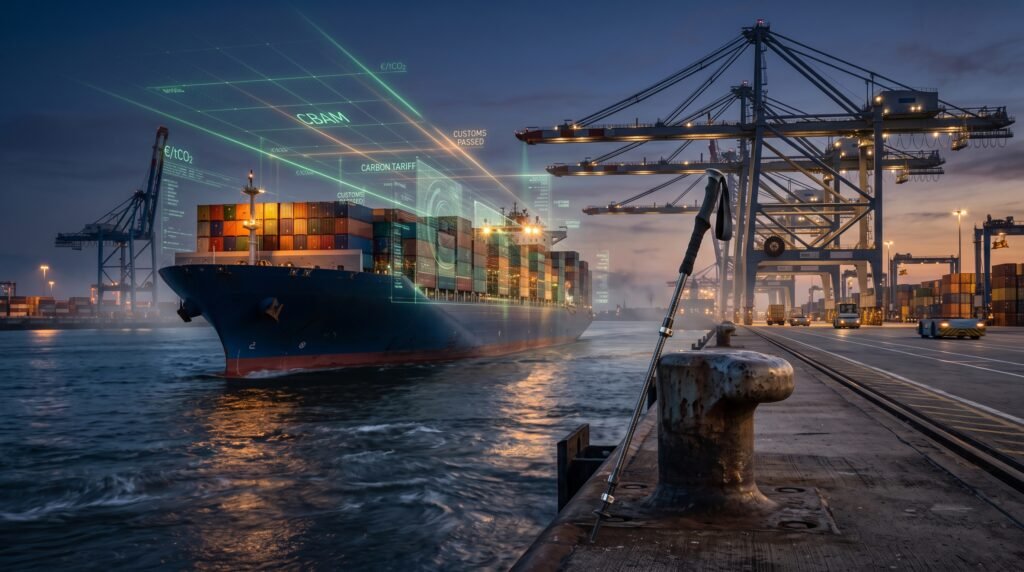
Radiography after nine months of tariff to the carbon on the EU.
Realignment of the imports from Asia, the shock judicial on the WTO and the pin of COSTS what stresses to industry
The day customs started appreciating smoke
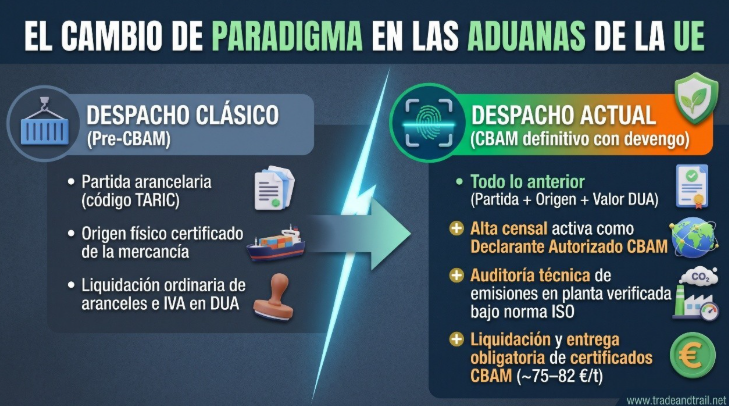
Until recently, importing merchandise to the EU was a predictable discipline: classifying the item in the TARIC, justifying the origin of the supplier and liquidating tariffs and VAT in the DUA. That scheme was blown up on January 1, when, after more than two years of transitory rehearsals, the Carbon Border Adjustment Mechanism (CBAM) activated its final financial regime.
Nine months later, the balance in community customs is historic: Customs no longer only controls the value of the cargo or its origin, but also how much carbon dioxide (CO₂) was issued to manufacture it on the other side of the planet. with a reference price that ranges between 75 and 82 €/tn CO₂ (Indexed to the EU ETS emission rights market), The ecological footprint has ceased to be a corporate slogan to become a real customs overrun that affects the industry and, by extension, European consumers.
In this article we review why CBAM exists, how it is charged in practice, which sectors it affects, how the world has reacted and what an importer can do today to protect its margin.
1. Why the CBAM exists: Climate Customs
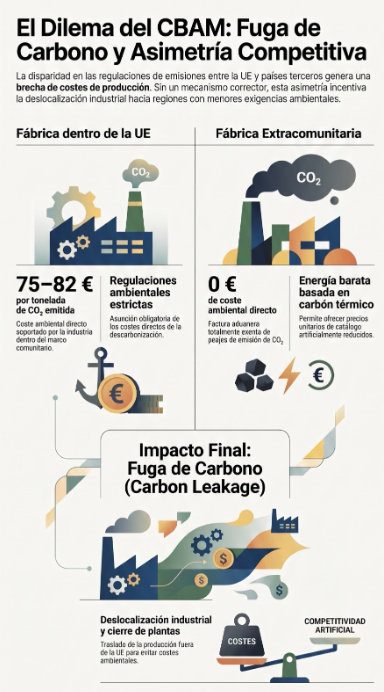
To understand this «commercial earthquake» you have to go back to the community market itself. Since 2005, the EU has had the Emission Rights Trade Regime (EU ETS), which forces large facilities (steels, refineries, chemicals, cement companies) to pay for each ton of CO₂ they emit. But with the hardening of the climate agenda (European Green Agreement and package Fit for 55), the price of carbon went from testimonial values to being structurally between €65 and €85/t.
That disparity put the European industry at a disadvantage: melting metal in Spain, Germany or France, Italy, Poland or any EEMM entailed direct environmental costs, while an outside producer could burn cheap coal and unload in European ports at unbeatable prices. To prevent the offshoring of factories (the dreaded”carbon leak or Carbon Leakage”), Brussels applied a shield for almost two decades: delivered free emission rights to their companies. But that patch stopped real decarbonisation: if polluting was free, no one had an incentive to invest in electric arc furnaces or green hydrogen.
Thus, in 2023 and within the European Green Agreement package, the Carbon Border Adjustment Mechanism (CBAM).
The CBAM (EU Regulation 2023/956) was designed to disarm that contradiction. It covers six sectors (steel and iron, aluminum, cement, fertilizer, hydrogen and electricity) and pursues three targets:
- Level the cost at destination: A ton of imported steel or aluminum faces the same surcharge for emissions at the border as if it had been manufactured in the EU.
- Withdraw local subsidies without unprotecting the industry: By charging the tax to the foreign product, Brussels can gradually withdraw free assignments to its European manufacturers (staggered calendar from 2026 to 2034).
- exert geopolitical pressure: A clear economic disincentive for large exporters to abandon fossil fuels if they want to continue accessing the largest consumer market on the planet.
2. How it is charged: The end of the trial period
From October 2023 to December 2025, the CBAM was a simple accounting year: importers collected data and filed quarterly statements without paying a single euro. But since January 1 of this year, this mechanism is already fully operational. Thus, at the moment the clearance of merchandise in customs is governed by three strict conditions.
Authorized declarant CBAM. Presenting a goods included in the regulations without this active authorization can lead to the precautionary retention of the container and the consequent computation of port expenses due to paralysis (demurrage). However, the simplification reform that has been carried out exempts importers that do not exceed 50 TN annuals of CBAM merchandise, except in hydrogen and electricity.
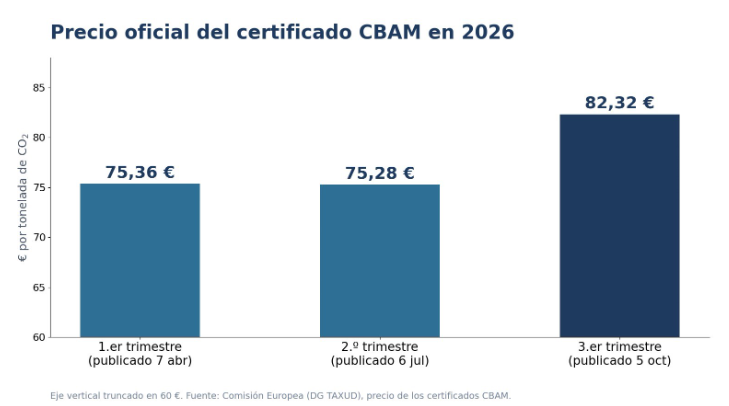
Settlement at market price. The importer calculates the tons of CO₂ incorporated into its purchases and, as of February 2027, will purchase equivalent CBAM certificates; The first annual statement, which covers imports of 2026, is due on September 30, 2027. Meanwhile, the Commission publishes a price per quarter, calculated as a weighted average of EU ETS auctions: €75.36/t in The first quarter of this year €75.28/t in the second quarter of this year and €82.32/t in the third (since 2027 will be weekly). In addition, the effective amount in 2026 is much lower than the gross cost, because the free allocation that European producers still retain is deducted (97.5% this year); That deduction is reduced every year until it disappears in 2034.
The punishment of default values. In order to declare real emissions, the foreign producer must provide installation data verified by an accredited verifier. If you do not send them, the importer must resort to the default values of the Commission, which are average by country and product, with a surcharge of 10% in 2026 (20% in 2027 and 30% since 2028) designed to push companies to measure their real emissions.
3. Who pays the toll: Sector X-ray
The crossing of data from the DG Taxud and from Eurostat Comext points to the fact that due to the entry of vigor of this mechanism, a reordering of the value chains is taking place..
The first effect that has already been seen in just these first nine months is the Appearance of a filter to imports: Unalloyed raw aluminum purchases from coal thermal foundries from countries like India would have fallen strongly, according to industry estimates that speak of year-on-year declines greater than 40%, while the presence of clean suppliers has been consolidated In nearby countries with hydraulic or efficient gas matrices (Nearshoring clean).
The Second immediate effect that has occurred is called: “export dilemma”, that we will analyze later in section 4.
Now let’s go into detail in seeing how this measure is affected by the main sectors included in it..
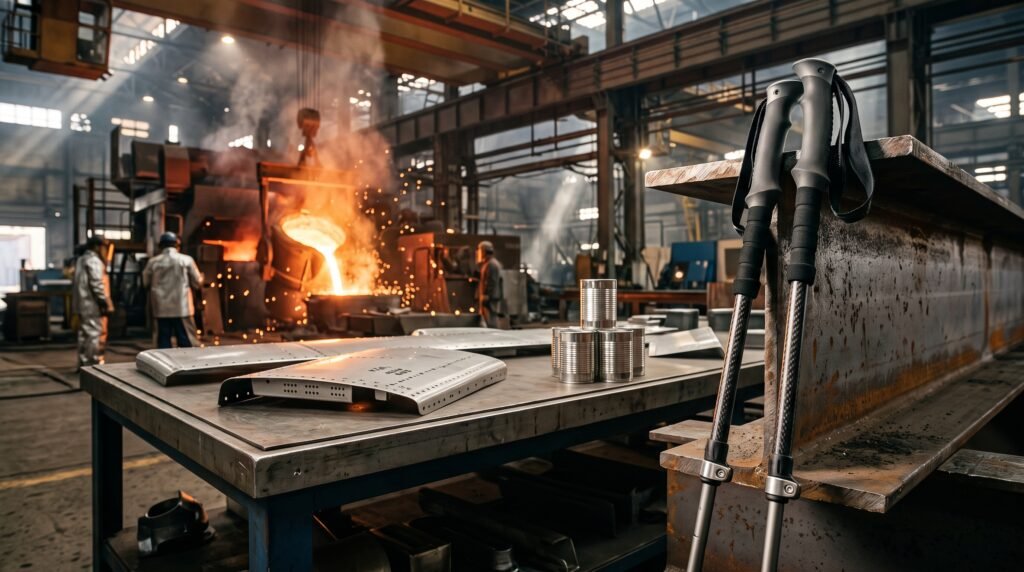
Steel and automotive: the opinion of Eurofer
Steel is the hard core of CBAM. Making a ton of primary steel by the conventional blast furnace process (BF-BOF) releases between 1.8 and 2.2 tons of CO₂ by the intensive use of coke coal. With the carbon in the environment of €75–82/tn, the direct gross cost, before discounting the free allocation, ranges from €130 and €165/tn imported metal.
The Eurofer employer puts the drop in EU steel exports to third countries by 20% in the first half of 2026. U.S. tariffs of 50% also influence (US sales have fallen a third), but Employer also stresses that European producers manufacture with decarbonisation cost overruns and lack compensation when exporting.
In the automotive industry, an average car requires, in order of magnitude, about 900 kg of steel between chassis, safety and engine reinforcements, so that the cost of the imported metal directly presses the margins of the builders in Spain, Germany or France. And since finished vehicles that arrive from Asia do not pay tolls, a perverse incentive is created: buy parts and engines assembled outside the EU to avoid the lien.
Aluminum and preserves: the warning of European Aluminum
Aluminum is the metal of lightness and energy transition, but its primary electrolysis consumes huge amounts of electricity. With thermal coal-based networks (frequent in Asia), one ton generates between 10 and 14 tonnes of CO₂, and the gross toll cost is between €750 and €1,050/Tn
This situation reaches the pantry at home itself: in fish, seafood and vegetable preserves, the metal (aluminium) container can account for around one-third of the total cost of production, so the increase in the cost of the primary aluminum reduces competitiveness to European packaging a Imported preserves ready for the linear.
The European Aluminum Association warns of the risk of the existence of a “Downstream Carbon Leakage” (downstream carbon leakage). That is, if the CBAM does not expand quickly to complex semi-finished and containers, cans, metallic carpentry and structural components, they will lose quota compared to manufactured products outside that avoid carbon payment.
Cement and clinker: the Mediterranean flank
Cement is probably the most exposed sector to the Mediterranean route. A very important part of the emissions of the clinker, its basic component, does not come from the fuel in the ovens but from the calcination of the limestone, so that changing energy is not enough to eliminate them. And the external supply is concentrated in a few origins: Turkey contributed about two-fifths of community cement and clinker imports in 2024, according to Cembureau, and in 2025 it was again the first supplier, with some 4.8 million tons, ahead of Ukraine (1.6), Egypt (1.3) and Algeria (1.2), according to Global Trade Tracker data.
What weighs the most is if the producer can credit his real emissions.
For portland gray cement imported in 2026, a cost of about €15/T If the supplier checks 0.82 t of CO₂ per ton, and a few €68-69/t With the default values of Egypt (1,419 t), Algeria (1,430 t) or Ukraine (1,518 t), with the EU ETS around €88.70 at the time of calculation.
This second figure exceeds the FOB price of Turkish or Egyptian cement (mid-high 50 $/tn), so that the price advantage that for years favored suppliers from Turkey and North Africa disappears. Turkey, moreover, has no national default value, which adds uncertainty to its main export market.
The result is a flow rearrangement: More weight for factories that verify their emissions or that work with gas, compared to those that depend on coke of oil and coal (such as the Egyptian ones). For public works and buildings, which buy cement in bulk and with adjusted margins, the risk is a readjustment of costs in tenders when the CBAM translates into effective payments from 2027.
Fertilizers and agriculture: the position of Fertilizers Europe
Nitrogenous fertilizers (urea, anhydrous ammonia, ammonium nitrate) are synthesized by the Haber-Bosch method, which requires intensive consumption of natural gas.An imported container from North Africa or the Middle East assumes an extra cost of 45 to €70/Tn When disembarking at a community port.
In fact, the fertilizers Europe Association Alert of the loss of autochthonous productive capacity and the volatility of the external supply. With such close margins, distributors and cooperatives fully transfer the surcharge to the farmer in the fertilizer bill, which fuels the inflationary pressure on the costs of production of basic food.
Table 1: Map of the impact of the CBAM by sectors after nine months
| Sector | Materia Prima Gravada | Sobfrecoste bruto directo | Industrias afectadas | Consecuencia en el mercado |
|---|---|---|---|---|
4. The Downstream Trap: Base Protection and Clamp on Manufacturing
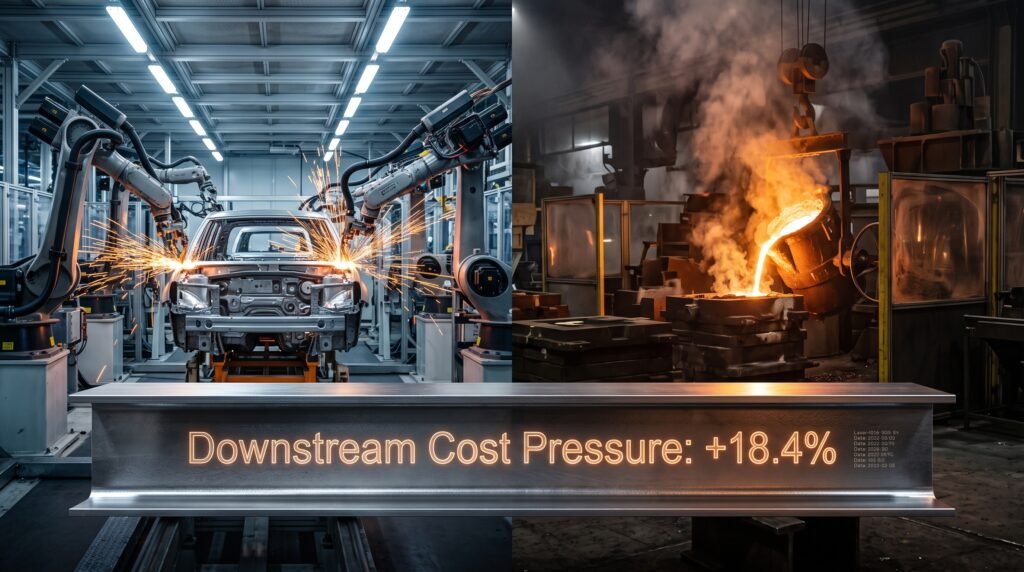
After nine months of definitive regime, the internal X-ray of the EU reveals a two-speed scenario,
which for the large basic producers is a necessary containment dam, for the transforming industries (Downstream): printed parts, automotive components, equipment goods, technical tools; It has become a cost clamp that compromises its global competitiveness.
The primary producer: a respite with an expiration date
For European manufacturers of raw steel, clinker or primary aluminum ingots, the CBAM acts as a leveler for the internal market: by taxing the extra-community metal of plants supported by thermal coal, it increases the foreign supply and it brings it closer to the cost structure of the European factories. But the mattress has a strict time limit:
- Gradual end of free rights: Until 2034, the Commission staggered away the free assignments (with an initial cut of 2.5% which will accelerate by 2030).
- Obligatory conversion: In order not to be out of the market as permits disappear, the heavy industry must undertake intensive investments in electric arc furnaces and direct green hydrogen reduction plants.
The value-added leak
The Gordian knot is in the middle link. By taxing only six raw materials sectors and a bounded semi-finished catalog, the current design creates an asymmetry: Buying raw steel sheet in Asia pays CBAM toll, but importing a pressed frame or a finished gear does not pay for it. Therefore, currently for A European company is more profitable to import the already assembled subset than to stamp it in Europe with local steel.
ESTA legal gap punishes three key sectors:
- Automotive and components: Chassis stampers, suspension arms and structural parts in Spain, Germany, France or Italy assume a more expensive raw material in customs (sectoral estimates place it between 12% and 26%, according to product and origin). If a builder imports the assembled set from Turkey or Asia, it evades the rate and weakens community manufacturing employment.
- Machinery and equipment goods: Manufacturers of presses, compressors or structures for wind energy are more expensive for their heavy forging inputs and lose margin in international tenders compared to rivals that produce with steel at standard cost.
- Precision Technical Manufactures: The aluminum calibrated tube shops of injection molds for industrial and sports components see how their customers are tempted to import the finished piece from factories outside the CBAM.
Export without return
Another of the problems that are being seen and that currently constitutes the main demand of the European export fabric is the Non-existence of an export adjustment mechanism (d)Export rebates).
In the single market, the CBAM protects the community factory from unfair competition. But when that same company sells in Latin America, the United States, Southeast Asia or the Persian Gulf, the scenario is reversed: it has assumed the cost of the EU ETS and the withdrawal of free duties, the customs does not restore or deduct the carbon when the cargo, and at destination competes against local manufacturers that produce no environmental tolls.
That’s one of the roots of the 20% drop in steel exports we’ve already seen, along with US tariffs: The mechanism protects domestic demand, but exposes the industry in global markets.
5. Clash in Geneva: the formal battle at the WTO
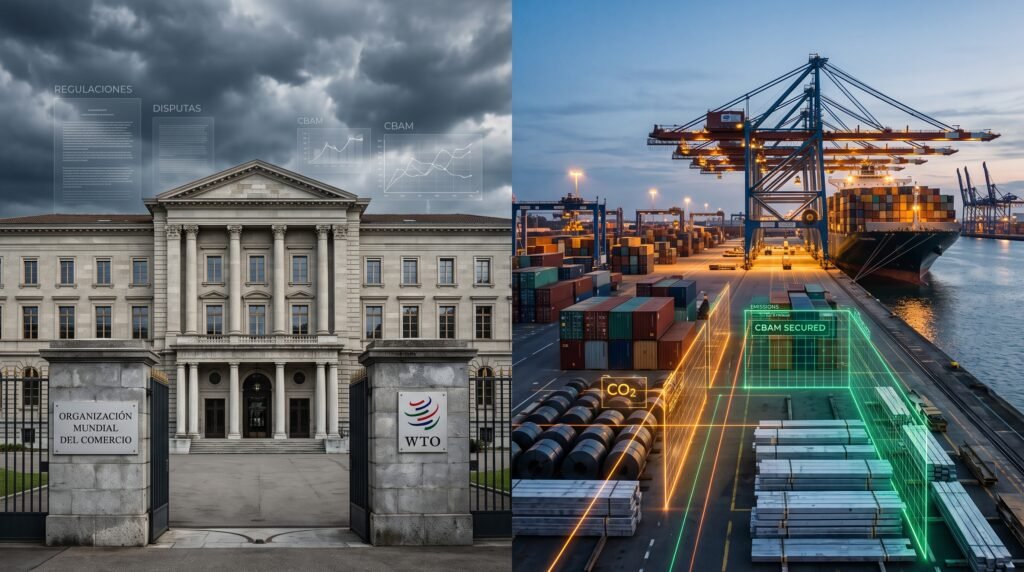
Carbon Customs has unleashed a diplomatic storm at the headquarters of the World Trade Organization (WTO). On September 25, 2026, the Dispute Settlement Body (DSB) agreed to establish a panel against the EU at the request of the Russian Federation, which began the dispute in May 2025 and also questions an alleged export subsidy within the EU ETS. a total of 18 members, including Indian woman, , China, Brazil, United Kingdom, United States and Canada, have reserved rights as third parties.
The defense of Brussels. The EU covers the CBAM in the environmental exceptions of Article XX of the GATT (Environment Protection), maintaining that there is no geographical discrimination, since CO₂ is taxed, and not the origin of the merchandise; presenting it as a stimulus to build a “Climate Club”
reproaches from exporters. While the affected countries articulate two underlying objections:
- National Treatment (Art. III GATT) and Most Favored Nation (Art. I): The GATT prohibits giving less favorable treatment to the foreign product. The Global South denounces that the EU requires exporters to pay 100% of the carbon bill from the first day, while maintaining free provisional rights to their local industries until 2034.
- Common but differentiated responsibilities: Emerging economies like India or South Africa recall that Europe boosted its development by burning fossil fuels for two centuries. Demand an identical surcharge when their electrical network depends on coal slowing their growth and violating UN climate agreements.
the risk of retaliation. With the WTO Appellate Body blocked and inoperative due to the lack of appointment of judges, the door is opened for the affected countries to impose unilateral compensatory fees on agri-food goods (wine, oil, cheese) or European machinery.
Table 2: The WTO Conflict Board and Exporters Reaction
| País / bloque | Acción diplomática en la OMC | Motivo de disconformidad | Estrategia comercial | Destino alternativo |
|---|---|---|---|---|
6. The Contagion Effect: United Kingdom, Canada and Australia
The implementation of the CBAM has forced the rest of Western economies to design their own border adjustments to avoid becoming recipients of the polluting metal that rules out Community customs (Trade fun).
Yes, there are currently 3 countries that are following the steps and the EU model, although with some differences:
- United Kingdom (entry into force on January 1, 2027): The United Kingdom has passed the primary law of its UK CBAM (Finance Act 2026) and finalizes secondary legislation; It will cover iron, steel, aluminum, cement, fertilizer and hydrogen. Unlike the EU certificate model, London will manage it as a direct tax collected and will allow the carbon costs paid at origin (such as the European STD) to be deducted to avoid double taxation.
- Canada (in the study phase): Ottawa explores a Border Carbon Adjustment that it would have to preserve the fluidity of the chains integrated with the United States under the T-MEC and mitigate the cross-tariff impact on steel and automotive, and that it would allow it to take advantage of its clean hydroelectric aluminum against Asian metal.
- Australia (Technical Review Completed): after his Carbon Leakage Review, the government is studying to introduce a mirror lien of its Safeguard Mechanism, starting with the cement and the clinker to later spread it to steel and ammonia. For now it is a proposal in consultation, without law in Parliament.
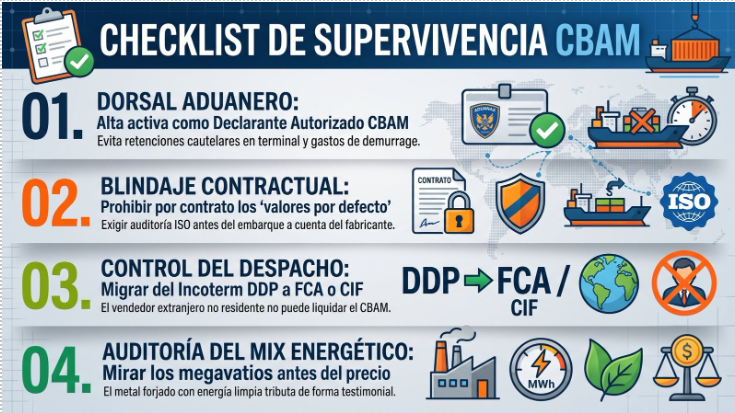
7. Four decisions to shield your business margin
The experience of these nine months advises to banish customs improvisation. If your company acquires or transforms inputs affected by the CBAM, these four decisions are non-negotiable:
- Formalize your status as an authorized declarant (your customs number). Do not delegate liability to the freight forwarder without verifying that it operates under express indirect representation; The authorization must be validated before the ship docks in port.
- Prohibits «default values» by contract. It conditions the payment of the items to the timely delivery of the emissions audit in the plant, verified by an accredited body and in charge of the manufacturer. Without it, the importer must use the commission’s generic tables, with a surcharge that rises from 10% to 30% until 2028.
- Check your incoterms. The non-EU seller cannot act as a CBAM reporter in the EU because it lacks legal personality in the Community territory. Leave the classic DDP and migrate to conditions FCA or CIF so that the importer maintains direct control of the clearance and the liquidation of certificates.
- Audit the electrical mix before the catalog. The lowest unit fob price no longer ensures the most profitable operation: buying profiles or parts in factories with a proven renewable supply reduces the toll to testimonial levels and turns decarbonization into a net margin advantage.
Conclusion
European customs has become a binding environmental filter where the ecological footprint of each factory has an accurate and liquidable price.
For importers, logistics operators and technical marks, improvisation translates into cut-out margins and locked containers.
Those who incorporate environmental traceability into their contracts, adjust their incoterms and bet on energy-efficient partners They will turn a complex regulatory toll into a solid competitive advantage to lead their market.
And remember, as we always say on Trade&Trail….
There is life beyond Turkey!!