
A new Yalta in Shenzhen? What was left of the summit between Trump, Xi and Putin to the world trade
The first summit trilateral between the three major nuclear powers ended with a declaration of minimum, without agreements on Ukraine and on trade, with a truce in tariff due on the 10th of January and with Europe out of the room.
Donald Trump, Xi Jinping and Vladimir Putin met on Thursday, November 19, 2026 at the villa Kylin, a complex state next to a lake in Shenzhen, in the first trilateral meeting between the leaders of the three major nuclear powers. The event is being held on the sidelines of the APEC summit, the Forum of Asia-Pacific Economic Cooperation, and without any european representative. Lasted about 80 minutes and ended with a joint declaration brief, commitments generic, without time limits or verification mechanisms, that did not mention Ukraine.
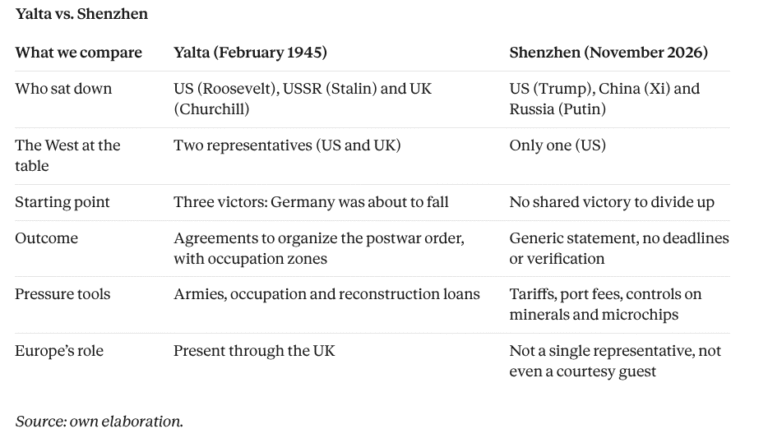
Before the appointment, there were some who baptized it as the «Yalta 2.0». In February, 1945, when Roosevelt, Churchill, and Stalin sat in the Crimea, the british and the americans had already opened the way in Germany and the soviet army had three months to take Berlin: the Big Three were winners, and set the foundations of the european order. In Shenzhen, none of the three came as a winner of nothing, and the results confirmed the more modest forecasts. But the image mattered more than the paper.
Who we are since the end of 2024 analyzing in TRADE&TRAIL how to undo the old globalization saw Shenzhen to come. It was like the provisioning of the mile 80 of a ultra mountain: runners head stop a moment, look askance to measure the bellows of the opponent and decide whether to agree on a common rhythm or strike in the next summit.
What happened in the villa Kylin
Trump met separately with Putin and Xi. Later, the three sat in a room dominated by a large round table made of wood. In the initial interventions, open to the press, each one marked his tone.
- Xi raised the summit as a joint effort to prevent another global conflict and maintain strategic stability.
- Putin evoked the allied victory in the Second World War and defended a cooperation based on mutual respect, equality and the balancing of interests.
- Trump, in a tone more content than usual, defended and negotiated directly to resolve wars as that of Ukraine.
In the nuclear field, there were contrasts. Trump suggested that the three reduced their arsenals, admitted that an agreement would be very difficult and said that Iran would never have a nuclear weapon. Xi described the nuclear weapons of the sword of Damocles and called for their total elimination, but Beijing refused to join a disarmament treaty.
At the end, the three countries spread statements identical. In them reaffirmed that a nuclear war cannot be won and should not get rid never, pledged to open a dialogue on risk reduction and nuclear non-proliferation, announced that they planned to increase the production and supply of refined petroleum products, was asked to reform the United Nations, and warned the International Criminal Court that I was not supposed to abuse your jurisdiction. The text lacked time limits, verification mechanisms and binding commitments, and did not mention Ukraine or a ceasefire or Iran.
That does not mean that Ukraine did not speak. Trump said after Putin wanted to close a deal, although the matter is not passed to the text. The minister of Foreign chinese, Wang Yi, said at the closing ceremony of the APEC that the three leaders had been exposed to face-to-face their strategic intentions and agreed to avoid conflicts and confrontations. Xi called the meeting constructive and fruitful, and Putin described as open and frank, and Trump got a 12 out of 10.
The forecasts more prudent (a brief meeting, a press release without concretions and unwillingness of China to limit its nuclear arsenal) were fulfilled on what is essential.
The movie that brought us up to Shenzhen
To understand why the photo of this meeting has weighed so much, it is appropriate to look in the rear view mirror. The board took time crunching.
2025: tariffs and routes. At the start of the second term of Trump, as avisábamos in our analysis of the risks and challenges of the geopolitical commercial for 2025 of an oncoming stage intense. In the EU-Mercosur Agreement , we propose the diversification as a european response. In march, we review the importance of the South China Sea and the domain of microchips with a network of ports in which China controls, directly or indirectly, 11 of the 15 largest in the world. In may, in the marathon geopolitics of the tariffs of the US, we picked up the rotation tariff of Washington: a 145% to China, and a truce for 90 days after the Geneva talks.
Fall 2025: climbing to Busan. In October, China said that he does not fear a war tariff faced with the threat of tariffs to 100 %. A few days later, Trump and Xi agreed in Busan , a truce of a year,. A week later, china customs showed that exports to the U.S. had dropped 25% year-on-year in October. Or even temporary relief to halt the disconnection.
November 2025: the pulse for the resources. We saw how Brazil went from pawn to player key after a cut tariff american 12,000 million dollars in agricultural products. Russia became the bananas and fertilizers in weapons of geopolitics in Latin America. And Beijing knitting a block mineral with 19 developing countries to shield the control of the rare earths.
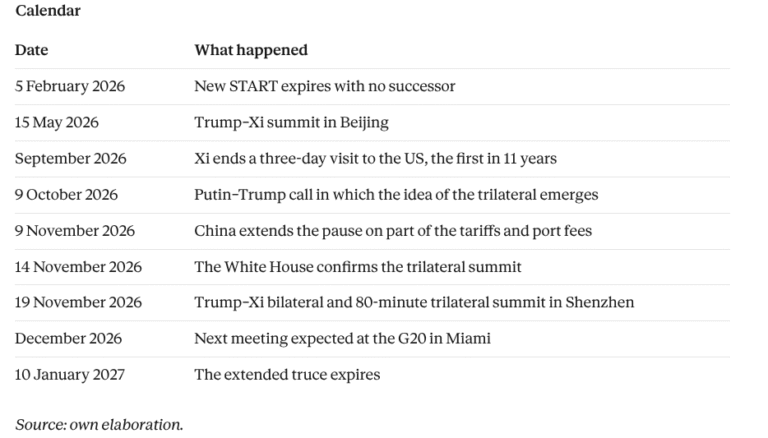
2026: the necks of the bottle. The voltage jumped from the offices to the physical routes. In April, we analyze the dual blockade of the strait of Hormuz, which shot the liquefied natural gas (LNG) and more expensive fertilizers. In June, the Covenant of Beijing premiered the concept of «managed trading», with commitments from china to purchase by 17,000 millions of dollars in agriculture and 200 Boeing in exchange for a freeze on new levies. Trump and Xi had met in Beijing on the 15th of may, in the first State visit of an american president to China in nine years.
An appointment that took weeks to close
The idea of a meeting to three departed from Putin. The Russian president proposed a meeting to discuss nuclear disarmament, and Trump was open to address other issues, including Ukraine. The proposal emerged in the telephone conversation, both held on the 9th of October. On 19 October, the EU responded that, if Putin wanted to end the war, could stop it on the same day, and he recalled that Europe had a role in any peace agreement. Kiev warned that the meeting will only be encouraged to Moscow.
Xi was the one who most resisted the format to three. The German president, Frank-Walter Steinmeier, said after a meeting with him that he had shown irritation when the possibility arose to include Ukraine in the agenda. The White House confirmed the summit on Friday, November 14, and Beijing did after, in a press release very soon. Trump went before the ASEAN summit in Manila and came to Shenzhen on Wednesday, 18. Xi broke the protocol and received him with a hug at the foot of the track.
A treaty expired, and three arsenals
The backdrop of nuclear explained the interest of Washington and Moscow. The New START will expired on February 5, 2026 without that the US and Russia to renew, and China did not participate in any renegotiation. The treaty limited each party to 1,550 strategic warheads operational and 800 launchers. In September 2025, the Kremlin had offered to respect those limits to a year, without verification. And Russia and the USA ceased to publish aggregated figures of their strategic forces.
The figures in the Yearbook SIPRI 2026, developed by the Swedish institute that follows the arsenals, we show the asymmetry between the three:
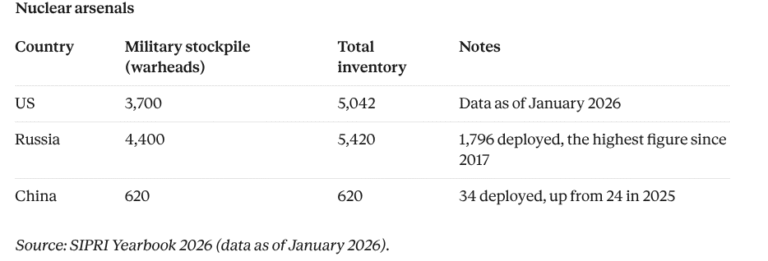
It is advisable to read these numbers. The US and Russia are concentrated around 83 % of the warheads in the arsenals of military. China went from about 600 warheads to about 620 in a year: 20 more, an increase of 3 %. Military arsenal of Russian became a 4.309 4,400, that is to say, 91 more. In absolute numbers, the increase in Russian was higher than that of the chinese, and the arsenal chinese continues to be between six and seven times lower than that of Russia or the USA.
The concern in Washington is not the actual photo, but the trend. China built missile silos, and went up from 24 to 34 deployed warheads, and the SIPRI warns that, depending on how you structure your forces, could equal the US or Russia in intercontinental ballistic missiles at the end of the decade. This difference is explained positions: Trump wanted China in a deal, and Beijing, with an arsenal that he considers very bottom, he saw no reason to negotiate. The result was a promise of dialogue, not reductions. In our judgment, is the most promising of the final text, but for now no promise.
Who ended up winning
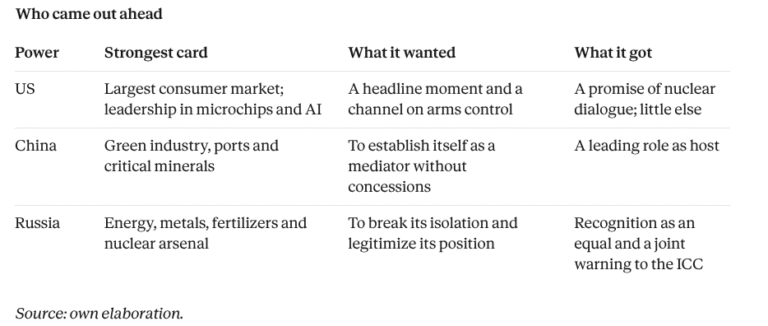
The statement was modest, and that modesty distributes the results of an uneven manner.
Russia. Putin was, in our judgment, the most benefited. Sat on an equal footing with Washington and Beijing, he broke the isolation and got a warning in conjunction with the International Criminal Court, which maintains a warrant out for your arrest. He did so with an economy very much lower than that of the other two powers, and a war that he met nearly five years ago: his seat, which is explained by its nuclear arsenal, not by its economic weight.
China. The host aspired to consolidate to Beijing as a mediator indispensable without taking strategic concessions, and it did. We estimate that China has not suited him to project the image of a new Yalta or a division of spheres of influence, and that’s why the statement avoided any language of that type. Xi called the meeting of the pioneer, and presented as crisis management, not as a division of the world.
United States. Trump arrived weakened. The republicans had lost control of both chambers in the mid-term elections, with the war of Iran and the price of energy as a backdrop, and to this was added the case for Nvidia. Needed to demonstrate that it was still telling, and open a channel on gun control. Came out with a statement of minimum and with his / her own assessment, a 12 out of 10.
Why Shenzhen
The place was not casual. Shenzhen is the core of a conurbation between Macau and Hong Kong, according to the plans of Xi, you must become a global centre of artificial intelligence. There have their headquarters Tencent, Huawei and BYD. In our opinion, the choice reinforces the image of a China technological and avant-garde, which presents the economy and technology as its international strategy, and that comes with the Communist Party Congress next year on the horizon.
Trade: the truce that is still maturing in January
Trump and Xi held before the trilateral its third bilateral meeting of the year. Trump praised at the beginning of the council of bilateral trade and said he had brought balance to the relationship. But the bilateral barely produced breakthroughs on the expiration of the truce in January, and the release chinese did not give details about an extension. Up to where it was known on Thursday night, none of the two governments had announced progress on the outstanding issues: chips, rare earths, tariffs, soy, or aircraft. Trump said he had spoken of artificial intelligence, with Xi, and that both perceived positive that there were few barriers to minimum.
We remember where we were. A one-year suspension agreed in November 2025 was due to expire within the week prior to the APEC. On the 9th of November, China extended to 10 January 2027-pause the additional fee of 24 % on american goods, and remained a levy of 10 %. His Ministry of Transportation continued until the same date the suspension of the port fees special vessels linked to the US. The requirement of china licenses for seven rare-earth medium and heavy, with effect from April 2025, remained in place. There still remained, in addition, a package of rebates reciprocal tariff on about 60,000 million $ in real non-sensitive (approximately 30,000 million for each side), which was announced at the end of September after the visit of Xi to Washington and still apply.
A truce seems to be a refreshment: it gives a breath and let the journey as I was. Most likely, in our judgment, is a new extension, and the negotiation serious seems to be reserved for the G20 summit in Miami in December.
A new Yalta? What that looks like and what not
There are three reasons not to carry the analogy too far. In 1945 was a victory, and in Shenzhen, there was no. The host, who was who went benefited, rejected the label. And the agenda is not included deals territorial or signed nothing comparable to what was agreed in the Crimea. For his material output, the summit can hardly be called historical.
But its value is symbolic, and in international politics the symbols to operate as facts. The image of three powers talking about the architecture of security, energy, and international institutions without the multilateral institutions in the room was, in our judgment, what really mattered. And there is the thing that counts: the decisions that most affect the rest are spoken among a few.
Those who were not in the room
European Union. For the first time since the end of the Cold War, three powers discussed the architecture of continental security and the outcome of a war on european soil without a single european in the room. The Russian minister of Foreign affairs, Sergey Lavrov, had come to ridicule in public to the europeans, compared to the animals of a fairy tale Russian incapable of playing together a quartet. It hurts, and in our judgment it hurts the most because it has part of the reason: the EU has not translated its economic weight in autonomy military or in a voice diplomatic unique. Attributed to Henry Kissinger, although it is not confirmed that to say, the question of: «who to call when you want to speak to Europe«.
The recent events gave him the reason. In the previous days, the european leaders, meeting in a informal European Council in Dublin on the 13th of November, had established a coordination group for talks on Ukraine, formed by France, Germany, Italy, and Poland, along with the presidents of the Commission and the European Council. They have not appointed an envoy unique and the high representative, Kaja Kallas, who aspired to a greater role, was left without a seat. Moscow, for its part, said that there was no agreement on the inclusion of eu delegation in the next round.
There was also a tinge of relief. The statement did not include concessions on Ukraine on european security, and the matter did not seem to occupy a central place in the conversation. Those fears came from far away: in may because it was feared in Brussels and Berlin a «trade managed» between Trump and Xi, who left Europe in the background, and Brussels negotiate with Beijing from June to reduce a trade deficit that stood at billion euros a day. We estimate that the EU was, in Shenzhen, as an actor without the weight of its own at the table.
Japan. The first minister, Sanae Takaichi, reported in the G7 in June, the economic coercion of China and the export controls of critical minerals. After the bilateral between Trump and Xi, said that Japan’s position on Taiwan remained the same and continued to close the meeting.
BRICS. The bloc held its 18.Th summit in New Delhi on 12 and 13 September. Brings together eleven full members and China will assume its presidency in 2027. Lula did not attend, and Modi worked to keep the group for a referral to a vehicle anti-western. The Global South it seemed to the audience that Beijing wanted to direct the message of Shenzhen.
We had already warned that Europe could end up being collateral damage. Our analysis of the EU-Mercosur agreement was already as a way of winning margin of maneuver in a trade increasingly fragmented.
What changes for companies
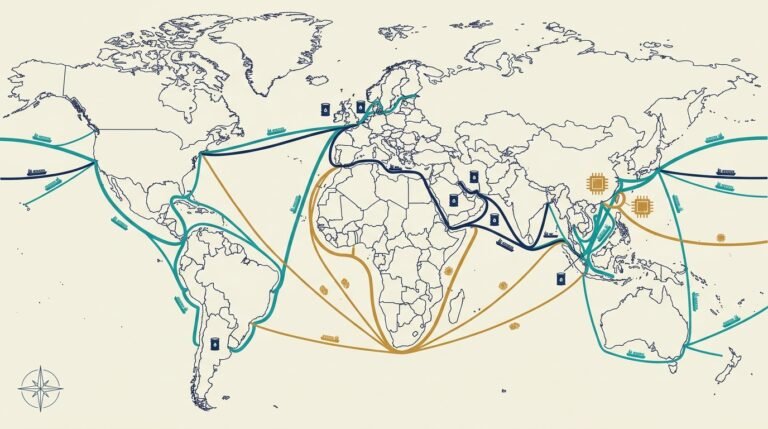
In a career trail, which puts you in dire straits is usually not the slope that looks drawn in the profile, but a change of the weather when it is already at the top. In international trade it is something similar: many companies have designed their supply chains thinking of a clear sky that long ago disappeared. The summit did not alter any customs duty or any rule, but left four signals:
1. The «managed trading» is still in force. Without the extension, announced the truce expires on the 10th of January, and the negotiation serious seems to move to the G20 summit in December. As we picked up in may 2025, the lock of the Appellate Body of the WTO (World Trade Organization) and the expanded use of the exception of national security of the GATT. The result is a legal uncertainty permanent for those who have no muscle political behind.
2. Technology: barriers to define. The event, Nvidia showed how sensitive are the controls on the export of chips, and Trump spoke about artificial intelligence, with Xi no commitments. As we pointed out in march of 2025, the taiwanese company TSMC produces more than 50% of the semiconductors in the world and more than 90 % of the most advanced, and your shipments crossing the South China Sea. For any importer, european, or to certify the origin and the traceability of each component (compliance customs) is already a game-fixed costs.
3. Energy: a promise without details. The three countries announced that they planned to increase the production and supply of refined oil, without numbers or time limits, and no mention of Iran. In April, we picked up almost 20% of the global flow of LNG passes through Hormuz. This is not to return to the cheap prices of before, but lurching require coverage fine.
4. Europe, in the way of the surplus. If Washington and Beijing strike a truce selective, Europe runs the risk of receiving the surplus industrial chinese which does not fit into the american market. Already in November 2025 we collected the chinese exports to the EU grew by 1%, while those directed to the US fell by 25 %.
What remains to know
There remain a number of unknowns. It is not known if there will be a second trilateral meeting, or if the promise of dialogue will launch a formal negotiations on arms control. Nor is there any data that the EU, Japan and the BRICS have been consulted. And the date that the heavier for those who traded with China or the US is not that of the 19 of November, but the 10 of January, with an appointment intermediate at the G20 summit in December.
Our reading is that Shenzhen did not set any new order, but it showed how they negotiated the coming: few actors, texts and generic schedules that change from one summit to another. The globalization comfortable in that only mattered who made a few cents cheaper stayed behind. Today weighs as much affinity geopolitics as the cost of freight.
And to end as we always say in TRADE&TRAIL, remember… THERE is LIFE BEYOND TURKEY!
For inquiries or collaborations, you can contact us through our contact page.